Monday, 22 August 2016

Sonnet 20


Is the Fair Youth male or female? Describing a man as a woman or woman as a man? If ever there as a mind boggling maybe even bizarre Sonnet yet, this is the one. The one sure case is whatever sort of love or relationship this is, it isn't sexual or superficial depending on how literally, figuratively or connotatively one wants to interpret the final line of the Sonnet.
The opening phrase, "A woman's face," immediately prompts the reader to make a mental image of what is to come ( an endearing description of the Fair Youth) based mostly on the attractive features of a woman. Also loaded in this phrase is the allusion that the Fair Youth is a man even though that is open for debate later on in the Sonnet. Shakespeare also then calls on the connotations of natural elegance in this first line by asserting that the subject of his Sonnet is nature own fabrication. The same nature he willed Time to ravage in Sonnet 19.
Line two oozes with metaphoric significance as it shrouds this and possibly every other Sonnet in mystery. This seems to be the one point where one could be able to conclusively establish the gender of the Fair Youth and yet the juxtaposition of "master-mistress" serves only to incite more debate and extensively conflicting theories. On the face of it, it seems as if the persona is trying to establish doubt and confusion in the reader as the Youth is both master and mistress. Biologically impossible, so one is forced to conclude that maybe on an entirely emotional or psychological level, Shakespeare seeks to think of the Fair Youth as possessing female and male inclined characteristics or possibly mannerisms concurrently. A concept which may seem complex and rare yet is very much a common and pivotal part of our daily lives.
The afore-mentioned theory is all but confirmed in lines 3,4 and 5 as the Youth is said to have the heart of a woman but not as fleeting as the typical lady's heart is. Entwined in this fairly obvious dig at the love of women is the emergence of the fact that Shakespeare has seen the need for a particular gentleness only a woman can provide and has adorned the Fair Youth with it (the Fair Youth he has shown to us. A picture seeming a bit too good to be true). The continued 'trolling' of women and their behaviour in love or when feigning love, "...as is false woman's fashion...less false in rolling," hints at an inbred misogyny, possibly explaining such a strong love for another man or a moment of great emotional torture at the hands of some lady. If the latter is to be considered as the true source of this critical nature, this 'love', these Sonnets would then be the result or culmination of some sort of catharsis. Surely a 154 Sonnet catharsis is as good as any.
Greek mythology makes a bit of an appearance as the Youth's gaze apparently has in a literal sense, the Midas Touch, "Gilding the object whereupon it gazeth." Undoubtedly, the various abilities of the Greek Gods were pretty impressive but none had any quite as awe-inspiring as a 'magical gaze'; Shakespeare's Youth has that and to be placed on a higher level than the likes of Zeus, Athena, Apollo and Artemis  is quite something, something incredible, something beyond the realms of reality. Is this Youth some sort of god?
As has already been mentioned, the ending of the third quatrain stresses that Shakespeare has no sexual thoughts or plans when it comes to the Fair Youth as he implies that Nature's adorning him with male genitals was of no use to him; needless to say what he would have preferred to have instead. Unless of course he meant to make use of only the Fair Youth's posterior but that's an analysis for another day.

The final couplet seems to point to Shakespeare's knowledge and approval of an open relationship. He gets the love and the ladies get the Youth's body. How could he be willing to share something he adores so much, something so valuable, so rare. Does he not fear it will be marred? Apparently no, simply inexplicable.

Tuesday, 16 August 2016

Sonnet 19

Arguably the most notable feature of this Sonnet is that it is not directly addressing the Fair Youth or just a narrative of the former's beauty, but a decidedly desperate plea levelled at Time to spare the Youth. A Sonnet that is at least a tad contradictory considering that thus far that decadence brought about by the ravages of time was the epitome of inevitability. Surely not even Shakespeare can protect the Fair Youth from 'Time' or can he?

At this point it is well worth noting that this Sonnet hinges on the efficiency and exuberance  of Time's predatory characteristics hence the symbols, diction and metaphors used stem mainly from predatory animals or their traits.

Shakespeare generates a list of sorts of 'heinous' acts 'Time' is allowed to perform instead of ravaging the Fair Youth. Firstly is the "blunting of Lion's paws," an image in keeping with the predatory theme pervading the Sonnet. However, the true relevance of this particular request would emanate from the fact that a lion's claws are in fact quite nearly indestructible and exist for all of the lion's lifetime without so much as a tinge of degeneration. As if that is not enough of an unachievable task, the persona suggests that Time see to the implementation of an apocalyptic purge, one facilitated by Mother Nature herself. Sacrificing just about all of the World to spare the Youth seems just about right for Shakespeare as augmented in Line 7. If ever there was even the slightest doubt pertaining to how much love is borne by the poet for this individual, it is clear now Shakespeare will go to all lengths to save his beloved. Could a love so deep really exist?

The first quatrain finishes with the most impossible command-cum-request  yet; to "burn a phoenix in her blood." A quite impossible feat according to Greek Mythology as the Phoenix  is said to regenerate from its own ashes after its 1 400 year periodic fiery death. The true significance of the use of this motif is probably that it symbolises the mystical, the unknown, the other realm. Juxtaposing this with known images like lions and tigers then serves to cater for the call to sacrifice all that exists in place of the Fair Youth.

In the second quatrain, he persona, in no uncertain terms gives Time free reign over the whole World, "And do whate'er thou wilt swift-footed time." Whilst of course this is only a metaphorical representation of what Shakespeare would do for the Fair Youth; in the spirit of analysis one should note that this 'love' is exceedingly looking like an obsession, an obsession so strong and so vile that nothing else matters. A bit uncharacteristic of Shakespeare as in other writings most notably those involving love ( Romeo and Juliet, As You Like It and Merchant Of Venice) he seems to satirise the ideology of people being controlled by love. Why has he succumbed?

As in every other Shakespearean Sonnet, the third quatrain concludes the argument. Time's tools of destruction are all given special mention as if as reminder as to what exactly is to be done. The most interest part of this quatrain is that Shakespeare points only to old age, "... my love's fair brow... nor draw lines with thine antique pen," and not death. Is it that his main concern is for the beauty of the Fair Youth and not the actual person. Is this some sort of superficial love?

Just as in the previous Sonnet, the poet provides a bit of insurance should his pleas fail. His love is to live forever through his writing if Time refuses to grant his wishes. Some critics have gone on to perceive the last line," My love in my verse shall ever live young," as a valediction meant to indicate that the first group of Sonnets ends here whilst to some it's a proclamation of victory against "devouring" Time.


A copy of this analysis is available for download at https://independent.academia.edu/KudzaiMahwite

Saturday, 6 August 2016

Sonnet 18


Considered by some to be the epitome of Romantic Poetry, Sonnet 18 could be the most popular of the 154 Sonnets. A number of exegeses have revealed double meanings strewn just about everywhere thereby making it irrevocably one of the most evocative works in Romantic Literature. A personal favourite and interestingly highly regarded by those wanting to try their hand at Sonnet writing.

The Sonnet with a bit of a paradox as the famous question " Shall I compare thee to a summer's day" seems to beg for an answer in the negative and yet the next 11 lines are spent doing just that. It would then seem like this is in fact a rhetorical question seeing as there was gross flattery in the previous Sonnets and as a result there could would very little justified doubt that the Fair Youth is to be compared to a 'summer's day'. At this point it is a tad necessary to remember that a summer's day is often considered to be the paragon of the seasonal calendar. There is no better weather, scenery or atmosphere to enjoy than that of a summer's day.

Though seemingly impossible, the Fair Youth is out-rightly proclaimed as being "more lovely," immediately leaving to the imagination the true elegance of the Fair Youth. In order to adequately accentuate the Youth's superiority in 'looks'( or even in general), Shakespeare goes on to point out the most distinguished flaws of a summer day. Note the shift from the monotony of describing the Youth to describing what the Youth isn't. 

The theme of time's passing comes into play in the third line as all too soon, "rough winds" have their way with "the darling buds of May" a fate to be avoided by the Youth as expressed by the final couplet. Summer's fatal metamorphosis is further augmented through the use of the word "darling" whose connotations point to a girl's progression to womanhood. A step though celebrated and inevitable is on the face of it aging and a depreciation of beauty.

Juxtaposition of Summer's undesirable extremes, " ...too hot the eye of heaven shines" and "... often is his gold complexion dimm'd" serves to eke out a sense of abhorrence towards Summer whilst also casting the image of perfection regarding the Fair Youth. Facets of Summer that are usually acceptable are made to look like some sort of disaster.

Line 8 reflects a rather interesting change in philosophy from the Procreation Sonnets as the persona seems to imply that the passage of time might just be a matter of 'chance'; the concept of inevitability has been swept away since there is no desire to convince the Fair Youth to have children anymore. This does leave the persona looking a tad deceitful. Unlike Summer, the Youth's desirable qualities will not wane as who-so-ever reads this Sonnet would automatically would know just how beautiful the Fair Youth was. In this, Shakespeare makes a freakishly accurate prediction thereby also highlighting the power of writing. His Sonnets have become the offspring and have faired much better than any other form of preserving a legacy would have.

Quite evidently good writing is timeless.


A copy of this analysis is available for download at  https://independent.academia.edu/KudzaiMahwite

Thursday, 4 August 2016

Sonnet 17

This is the last of the Procreation Sonnets. After a number of supposedly futile attempts to convince out-rightly the Fair Youth to bear offspring, Sonnet 17 paves way for a barrage  of praise and flattery. Shakespeare also tries his hand at soothsaying with decidedly varied success. Yes there may be sceptics pertaining to the current descriptions of the Fair Youth and doubtless anything more would draw more disbelief but quite a number of us would probably have been willing to accept and appreciate whatever the persona deemed to be the true value of the Fair Youth.

The Sonnet begins with a seemingly rhetorical question meant to in the original case entice the Youth into believing that whatever elucidations the persona mustered were but a shadow of what he really felt. A decidedly wise route to take seeing as any description could then not be criticized as bad whilst at the same time making the Youth feel a whole lot better about himself. Shakespeare's self criticism is so useful in that whenever one critiques oneself the people's expectations are lowered and whatever comes seems good enough. Likening his writing to a "tomb" heightens this self-criticism whilst also richly augmenting the beauty of the Fair Youth for if such flattery verse is but a tomb, only the wildest of imaginations can fathom what or whom the Fair Youth actually is.

Repetition of the conjunction "if" to begin the second quatrain serves as a lamentation of sorts to properly express the dire regret Shakespeare feels at apparently not being able to capture  the true beauty of the Fair Youth in writing. Some will say it is just continued adulation but even if only for a moment let us assume it is completely true. If the greatest writer of all time cannot in earnest do justice to the beauty of this creature then surely he must have been quite simply a sight for the sorest of eyes; never to be seen again unless he did have children.

The third quatrain brings forth a rather sad feel to the Sonnet as the predictions within are so logical they have to be true. Instead of accepting the beauty of the Fair Youth and sharing it, we instead point to the quality and flamboyance of the persona. These Sonnets are "... termed a poet's rage" with the true memory of the Fair Youth embroidered only in mystery. Such is the importance of having children for an 'everlasting' legacy. None of us have Shakespeare to document our qualities so best we do our own documentation in whatever way possible.


A Sonnet of great quality no doubt but more importantly a plea to all to find the best way to leave an everlasting memory.

A copy of this analysis is available at https://independent.academia.edu/KudzaiMahwite

Saturday, 30 July 2016

Sonnet 16


Forming a diptych with Sonnet 15, Sonnet 16 explicitly puts forward the encouragement of procreation where the previous Sonnet was seemingly lacking. The major theme, aside from procreation itself is the Fair Youth's pretendedly oblivious stance towards Time and its effects of atrophy.

The Sonnet begins with the conjunction "But," a clear continuation from Sonnet 15. Shakespeare is supplicating the Fair Youth why he is so torpid in the battle against Time. The imploring tone serves to highlight the dire gravity of the matter. As if to augment the ruinous state of affairs, the persona makes use of war imagery, "... bloody tyrant,...fortify yourself. " It's pretty incredible to note that the Fair Youth is willing to face a tyrant, a destroyer, a merciless ruiner. However, the hyperbole becomes apparent when the prescribed sentinel is procreation. Surely bearing offspring cannot absolutely make different one's life as alluded to by Shakespeare or can it?

Line 4 brings forward a rather rare form of diffidence as Shakespeare so easily belittles his own writing. Doubtless he knew his abilities but in this line so openly concedes they are worth nothing when pitted against Time. This act of humility is even more striking when one considers that Shakespeare often writes as a thoroughly observant demigod. So deeply sincere is the capitulation that an almost comical pun in "barren rhyme" ameliorates the concession. Howbeit, this may just be an extremely elaborate veneer meant to aid in convincing the Fair Youth to have children.

The second quatrain explores the fact that the Youth is in his prime and should thus have no difficulty in finding a partner with whom to bear children. Up to this point, Shakespeare seemed to be referring predominantly to a physical beauty and yet if "... many maiden gardens ...would bear you living flowers," the Fair Youth was probably a man of respectable social standing. The gardening images and references used in this quatrain are also worth noting especially as they seem to portray women as mere superabundant vessels of fertility waiting eagerly for seeds to bear children. A thoroughly misplaced maybe even offensive view of women though pretty conventional in Elizabethan times.

In the final quatrain, Shakespeare emphasises that no work of his or indeed any other artist can replicate the Fair Youth's beauty as seen by men. A notion which is possibly better interpreted in saying nobody can recreate life or youth should time work its irreversible magic.

As always the resolution is to have children but this particular Sonnet has a bit of a twist in that; though slightly veiled, the person implies that having children to tell of one's legacy ensure it is told in the way one desires unlike having outsiders tell it. So best to bear offspring rather than have photographs tell your story.

Wednesday, 27 July 2016

Sonnet 15


This beguiling Sonnet is a contemplation of life in its most recondite state. Undoubtedly, its most bemusing characteristic is that there is no explicit encouragement to procreate from the persona. A change of strategy perhaps to aid in trying to coax the Fair Youth into bearing offspring.
Line 1 reflects an extensive rumination on the concept of life and growth. It is also the beginning of the comparison between the Youth and all else that stake a claim to life. It is as if Shakespeare laments the temporary nature of perfection, "... in perfection but a little moment," and he does so with good reason as it becomes apparent that like all else, the current state of the Fair Youth will inevitably depreciate. Just as in 'AS YOU LIKE IT' Act 2 Scene 7, Shakespeare likens the world to a stage in Line 3 not as a way to debase the roles of all and sundry but rather to allude to the irrevocable importance of the Fair Youth sticking to his script (procreating) as failure to deliver would mar the whole performance ( world as prescribed by the prevailing metaphor).
In true stage fashion, there is a director(the stars) orchestrating every movement. However, it seems a tad bizarre that Shakespeare should acknowledge the existence and power of 'fate' or at least some pre-determining force given the seemingly heated criticism of such in Sonnet 14. He might be going so far as to allude to the existence of a 'God' from line 6, "cheered and checked ev'n by the self-same sky" apparently therein the heavens lies a power as is common belief among all religious congregations.
Just as perfection appears, the wears of life pervade its actuality casting the reader back to line 2. The beauty in its abundance is spent gradually, "... wear their brave state out of memory," to fade away into oblivion if an heir is not to be found. The stakes get even higher against the Fair Youth as it isn't just time lying in wait but also 'decay' in its boldest form. Though fairly common in Shakespeare's writing, the image of day to sunset further augments the concept of the receding of Youth into nihility.
The final couplet is probably the most significant of any other thusfar as Shakespeare instigates a totally new view to the Sonnets. Instead of them just being pleas for procreation, the persona is using the Sonnets to perpetuate in print the allure of the Fair Youth. Was this procreation all just a plea for the Fair Youth to be a willing part of these writings or they were to write too or the Sonnets are in fact the procreation?

We are all left to wonder.

Saturday, 23 July 2016

Sonnet 14

Just in case the Fair Youth or any of us were thinking Shakespeare is some sort of psychic based on his insights on the likelihood of negative events regarding  the ravages of time, Sonnet 14 extinguishes any such thoughts thereby giving the persona a more humanely outlook. The theme of procreation continues and hinges on the comparison between the 'stars' and the Youth's 'eyes', a fairly common comparison in matters involving love where the beloved assumes qualities of everything that is angelic.
Beginning the Sonnet with the word "Not" serves to give it a somewhat categorical feel capturing the attention of the reader; most importantly the Fair Youth. In this first line, Shakespeare also alludes to there being an aura of doubt or disbelief at the use of stars to tell fortunes through the slightly mocking tone the line assumes. As a continued criticism of  fortune tellers, the persona plays on the fact that they often group their visions in only good and evil, "... of good or evil luck," when surely there has to be more than just that. It is probably worth noting that "astrology" ( as defined at the Sonnet's time of construction) played a pivotal role in determining the behaviour of individuals at just about every level of society. However, based on Shakespeare's supposed satirising of this concept, certain individuals who were or thought themselves to be learned were vastly critical of fortune telling as a result as we shall assume the Fair Youth and Shakespeare shared in this disbelieving state, the assertion of procreation would hold more strength if it was distanced from "astrology" as the persona aptly does.
A look at the list that Shakespeare makes of things he cannot foretell would seem as if he can tell very little if anything at all thereby disencumbering  himself from the advisory pedestal the previous Sonnets had facilitated. Why then should the Fair Youth believe or be convinced by one who cannot "...tell of plagues or dearths" or "thunder, rain and wind" that which should be trivial work for any half decent  fortuneteller.
The third quatrain swiftly brushes away any doubts as alas, the persona needs not the stars but the Fair Youth's eyes. Not only does this reflect glowingly on the persona's prognostication talent but also heightens the supposed beauty of the Youth's eyes as they supposedly work just as well as stars at least in the eyes of a sibyl. Through the thriving of truth and beauty, procreation is to take place.  A rather complex message to derive from one's eyes and yet a fitting message as the previous Sonnets reflect.

The final couplet presents a bit of irony as in trying to present the demise of beauty, the persona does in fact predict death contrary to what he seemed to assert earlier in the Sonnet. It seems he is indeed just a regular oracle after all.

Thursday, 30 June 2016

Sonnet 13

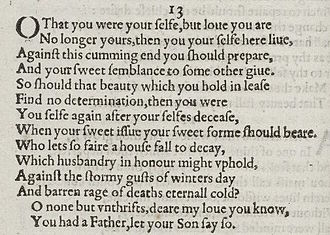
Shakespeare has appealed to the Fair Youth's heritage once before seemingly without much success, a number of contrasting and sometimes complimentary metaphors have ensued but now in Sonnet 13, he seeks to use his own affection towards the Youth as a motivation for him to consider and possibly implement the idea of procreation. Sonnet 13 also reflects a conspicuous leap in the intensity of intimacy between the persona and the Fair Youth as it is the first time words like "Love" and "My dear love..." are used.
Lamentation ensues in the first line, "O that you were yourself," with the persona seemingly appealing to a time when things were different. A time when the Fair Youth was possibly more understanding or a time when this ever evolving beauty manifested itself in a more lasting manner, a form less ravaged by time, a form not so near its ultimate demise. The keening continues into line 2 with an assertion-cum- reminder that the Fair Youth's allure only exists as long as he lives thereby further postulating the need for procreation. The next line further augments this notion in the most perspicuous manner; a straightforward assertion, "Against this coming end you should prepare."
As if to say the metaphorical approach has been ineffective it seems the persona has turned to clarity so as to make certain his wish is granted. Shakespeare's  writing is customarily saturated with metaphoric relevance such that in the first thirteen Sonnets this may be the pinnacle of pleas and entreaties. The culmination of a crescendo, maybe the moment the Fair Youth is to start believing or the quest to convince him assumes a renewed vigour.
In a fairly swift return to convention, the Fair Youth's beauty is likened to a house. Who in their right mind would let such a house succumb to the elements with full knowledge of what might save it the persona asks. Doubtless the Youth will have to look within and decide whether to be the irrational carefree housekeeper ( killing off his own beauty) or be the responsible individual and do what is required to maintain the metaphoric house ( his beauty).

The final couplet is the highlight of Sonnet 13 as it contains an unequivocal show or confirmation of the intensity of affection borne by the persona for the Fair Youth. He is referenced as "... my love" for the first time thereby marking a shift in tone henceforth. A metamorphosis likely to herald a new breed of metaphors and imagery in the Sonnets that follow and hopefully a change of heart from the Fair Youth.

Sunday, 26 June 2016

Sonnet 12

Another one of the procreation Sonnets with slight yet incredibly interesting twist. In this Sonnet the persona openly concedes that the Fair Youth "will" or "must" go through the ravages of Time. Whether this is just to stir up fear within the Fair Youth or just a sincere concession is up for debate. Whatever the case may be, a sense of realism and practicality pervades the whole plea for procreation henceforth.
Line 1 makes use of the most obvious images of the passage of time, a clock seemingly congruent with the practical or realistic nature of this particular Sonnet. Furthermore the phrase " ...I do count..." conjures the feeling of an all-seeing persona, a persona with a bird's eye view of Time's progression, a somewhat seasoned campaigner when it comes to the effects of time. Surely such a person would know best how to take on mortality and yet the Fair Youth is ever incredulous to this line of thought.
The description of the Sun as brave in Line 2 portrays the defiance to the razing of time as a noble and worthy cause, a quest requiring courage. Courage the Fair Youth declines to exhibit. Does this then justify the misgivings the Fair Youth seems to have?
From clock to day, from day to luscious violet from violet to metamorphosing hair, from hair to seasonal tree all seemingly mundane yet necessary excerpts from life suffer from Time's destructive tendencies all under the watchful eye of the persona whose words of advice do not seem to be enough for the Fair Youth. Time seems so efficient, so ruthless, a grim reaper of sorts aiding each and every facet of the world to mortality.
Even the Fair Youth's beauty is to be tested by the strength of time, "That thou among the wastes of time must go" and surely how-so-ever prominent or awe-inspiring it cannot survive, for sure nothing against time's scythe can make defence and the only way to guard the beauty is to bear children.

Sunday, 8 May 2016

Sonnet 11

Just as the ones before it, this Sonnet is part of the procreation sequence directed at a younger man whom Shakespeare was supposedly in 'love' with. Effective comprehension of the themes established in this poem is entwined with an understanding of the ones before this one as line 7, "If all were minded so, the time should cease," a line which hinges on the belief that the reader already knows how the Fair Youth is 'minded'(his view on procreation) and thus the tactfulness and intensity of this episode of persuasion should not be a surprise.
Line 1 plunges straight into lamentation of time's ravages on the Fair Youth. The beauty is sure to 'wane'(diminish) and it will happen with considerable speed, a sombering thought for any who might want to witness such elegance in the future. However, hope exists also in that first line as the persona asserts that just as rapid as beauty is taken, it is given and it grows within the Fair Youth's heir. Naught is to be lost if only the Fair Youth were to bear offspring and so continues this raging plea.
Much like an investment, bearing offspring in fruitful youth, "And that fresh blood which youngly thou bestow'st," will prove worthwhile in old age, "Thou mayst call thine when thou from youth convertest," the thought of having an image of an illustrious past readily available to admire and reminisce upon every now and again appears to not be enough for the Fair Youth. He would rather avoid and such nostalgia for reasons that interestingly up to this point have not even been hinted at.
Shakespeare then makes an attempt to appeal to the subject's pride via a thinly veiled attack on the the Fair Youth's intellect by averring that the 'wise' choice is to have a child. Interlaced with this attack is a beseechment to all that one may value, "beauty and increase." Surely, the Fair Youth should succumb to the basest of desires ( adoration and perpetual profiting, riches probably). If not for that, then the fear of "age and cold decay" should reign supreme and force the Fair Youth even against his will to brook the 'burden' of having children.
Lines 7-9 reveal somewhat beguiling facets of the poet's nature. Whilst he seeming cares for  the perpetual existence of mankind, he seems rather ruthless when it comes to characters he considers for whatever reason not worth it, " featureless and rude." Such an attitude serves to cast a dark light on Elizabethan times as ones looks and etiquette avowedly defined whether their existence was worthwhile.

The final couplet entails a metaphor that elevates the Fair Youth to the level of second to Nature itself as he is considered the 'seal' from which all else good will be imitated. No creature as beautiful will be created henceforth and yet the Fair  Youth sees fit to rob the world of that one copy of perfection.